
Let’s go for a walk though the vineyard. It’s something I do every day. As you may know, I married into the La Biancara family. The house where we live backs onto the vineyard that becomes the Sassaia wine. These vineyards are farmed organically (and are certified as such) and we make wine only with grapes (so-called “natural wine”) and occasionally a small dose of SO2, but only when needed.
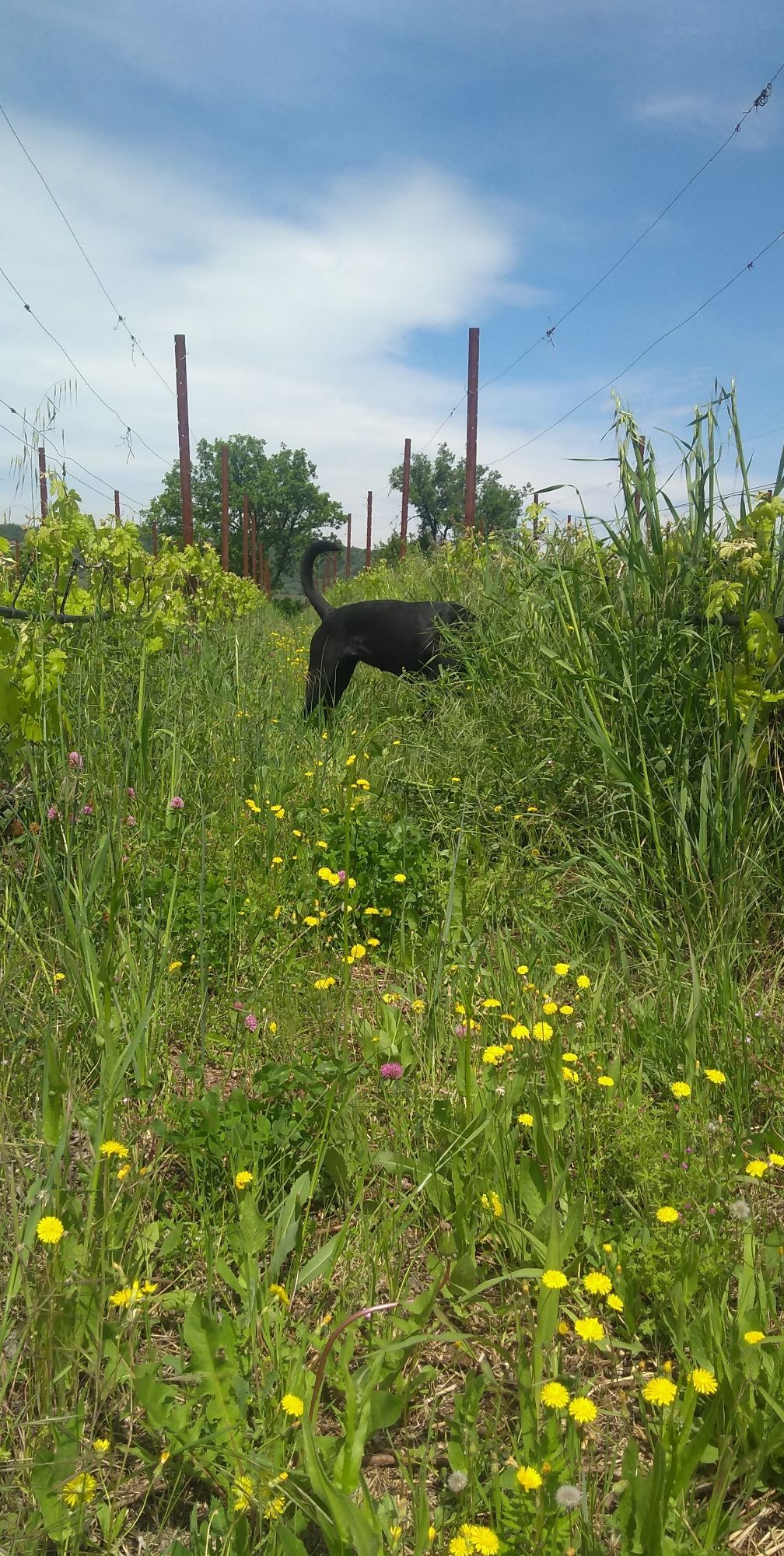
I’m going to leave the subsoil aside for now and just focus on what we can see. First, as you walk, watch where you’re putting your feet; it’s not always perfectly level. One of the brothers may have been through with the ripper or there may be prunings left on the ground. As you look down, you’ll notice that there’s not just grass, but there are long grasses, short grasses, all kinds of leaves, and there are also flowers. Engage your nose and you’ll smell pollen, some lemon balm, and sometimes mint. There is buzzing too because all the flowers bring insects. The greater variety of flowers means a greater variety of insects. There’s more biodiversity in nature than you could ever believe. In a pit-fall trap set in the vineyards last year, we had 794 individual ants from 14 different ant species! (I feel sorry for the person who had to count them!)
Also, I didn’t know before moving here that, even amongst insects, there is a predator-prey dynamic and the ratio that should ideally be as close to 1:1 as possible.
We have a friend from Florence who is a specialist in mites and he realised that in our vineyard there’s a decent population of phytoseiidae that eat the yellow and red spider mites whose prevalence is causing problems down in Tuscany. Our winter prunings therefore get taken down to wineries predominantly in Montalcino to redress their balance.

Obviously if you spray with herbicides, you’re going to kill the grasses and flowers that would have attracted the insects. If you spray with an insecticide, you have done the equivalent of launching a nuclear bomb at the local population.
You might think that nuking is the answer because it eliminates the enemy. But it’s what happens to your vineyard after the apocalypse that makes me realise that a more sustainable solution is needed. Agronomist Stefano Zaninotti used a metaphor once that was so good it has stayed in my mind ever since:
Imagine an IKEA or really popular supermarket car park. If you go there on a Saturday afternoon, you’re going to have to look hard for a free spot to park, you’re going to have to neatly squeeze yourself into the space that’s available and you probably won’t be able to fling open your car doors to get out. That’s your vineyard with a healthy, thriving insect population.
Now imagine that the car arrives at the supermarket on a quiet Tuesday morning. It has no problem finding a space to park, even if can probably take up two or three spaces is it wants and then can spread out quickly over a wide area. The car in this metaphor could be a pest such as scaphoideus titanus, the American grapevine leafhopper that causes flavescenza dorata. You won’t eliminate it in either situation – some situations you have to learn to live with – but it will cause a lot more damage in your vineyards if it arrives on a Tuesday rather than a Saturday.
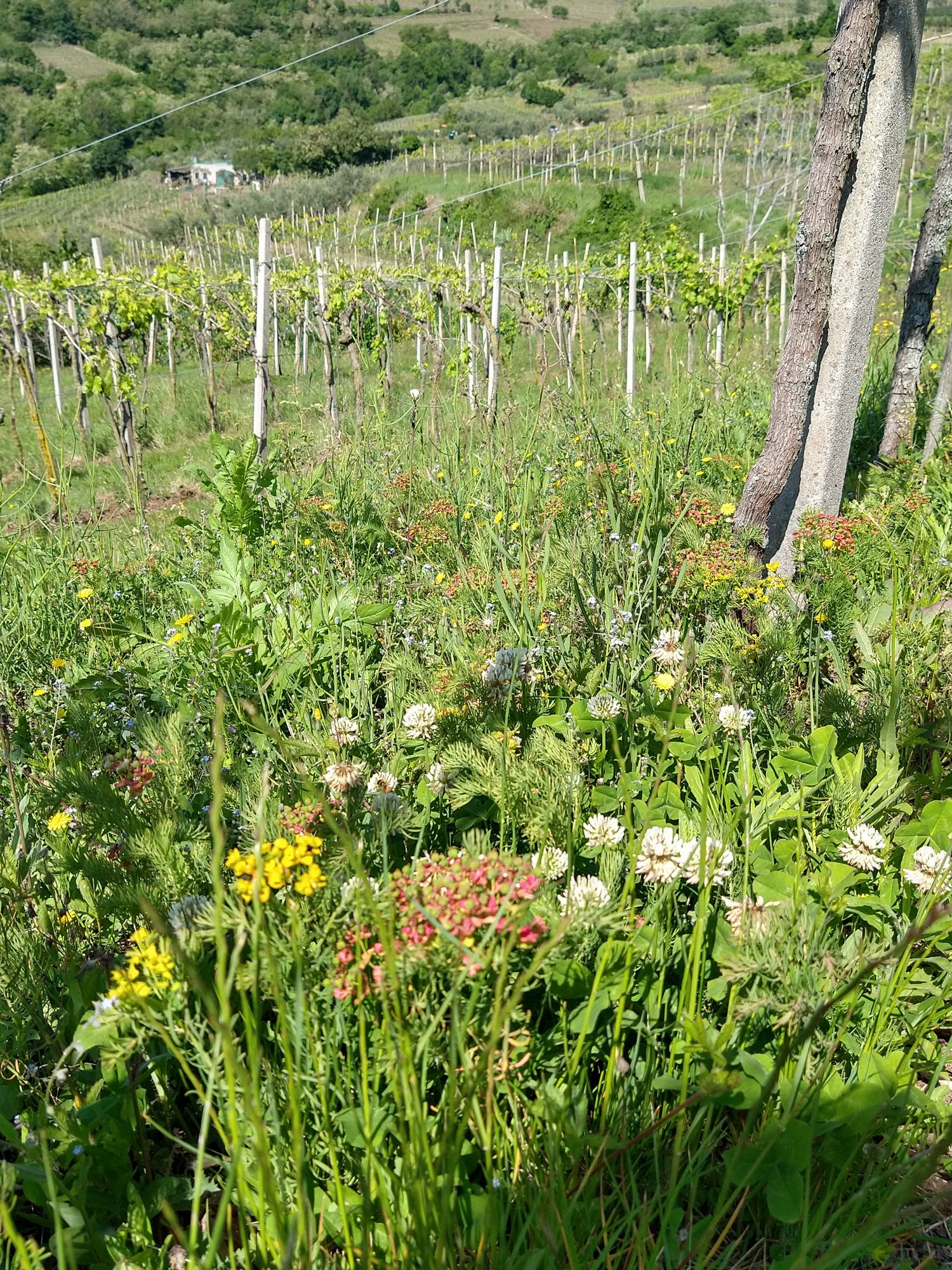
Anyway, let’s continue on our walk. You’ll notice that there are the insects that walk and those that fly. You will almost certainly see some bees if the weather is nice. My husband has three beehives from which he tries to make a bit of honey for the family. Sometimes we sow a couple of rows with bee-friendly flowers (often phacelia, as in the photo below) because in the last few years, the flowering of the acacia and the linden trees have coincided with rainfall so sources of nectar for our bees are limited. Climate change is a problem for them too.

If you’re lucky, you might see our resident pheasant scuttling away from us. If I take you over to the other side of the vineyard, that’s where you find the hares. And if we go through the woods on our way back down, you’re very likely to see the footprint of a wild boar and the paths they forge up and down the hillside.
Then there are the birds. Now, I’m the first to admit that my ability to recognise and name them could be much improved. We had a student from Holland come and visit the winery once who could recognise the species of bird just by their song. I wish I had written down all that he had heard; it was really impressive. In my garden, I know there is a robin and a family of tits. In the trees above are the magpies, sometimes four or six of them. Then, if there’s no wind, there’s nearly always a bird of prey hovering in the sky above our heads. There are two or three different types that I see most often. I’ll show you if you come and visit too.
That’s why I choose to support wineries that farm organically, at the very least. I guess the average person stops at the taste of a wine (and taste is important) but for me, it’s fundamental that the grower managing those vines is growing healthy grapes and maintaining harmony in the ecosystem of their vineyards. It might sound like that’s a lot of hard work and upkeep – and yes, it is harder to work organically than conventionally – but remember this, nature would have that balance by herself. It’s human invention which causes the disruption. What the grower needs to do is make responsible, reasonable, conscientious choices. And in an ideal world, the consumer should do the same when choosing what to buy.


Leave a comment