
Earlier this week I was at wine2wine, the networking forum in Verona organised by Stevie Kim & Vinitaly. I was very lucky to get a front row seat for the Tasting Session with Isabelle Legeron and Robert Joseph – a perfect match – talking about various aspects of natural wine. Isabelle very capably and eloquently advocating, and Robert prompting, probing, excelling in his role playing the devil.
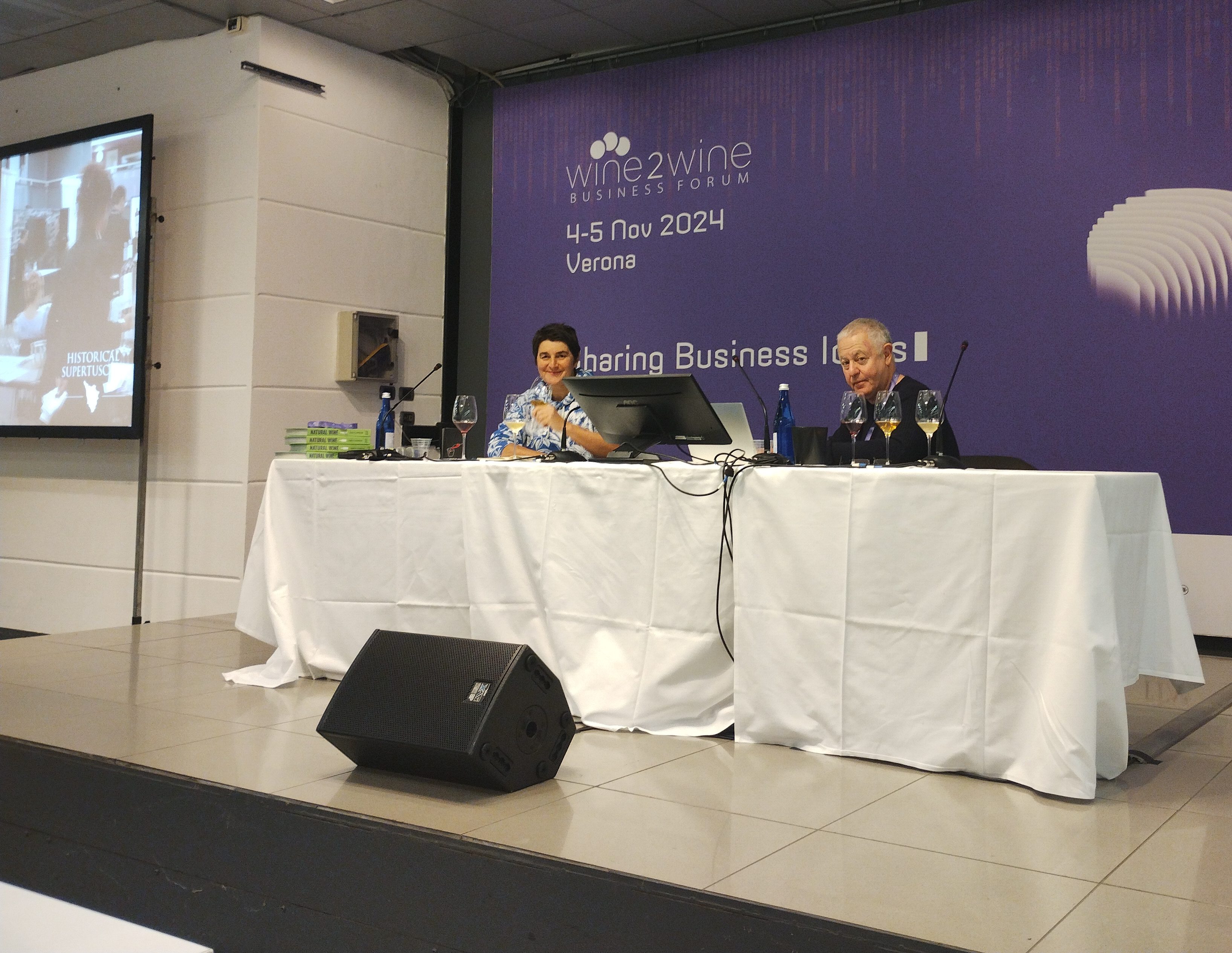
We tasted three different wines; the first – a delicious, juicy, refreshing tonic. The second – more powerful, with a hefty component of VA but which allowed Isabelle to talk about fragility in wines with no added SO2 [this particular wine was in the barrel for three years before being bottled and released meaning that the winemaker could sleep easy knowing that it was stable.] Then a third wine which for me was clear cut… but, this is how part of the conversation went.
Robert: I’ve had unfortunate experiences with faulty natural wines and with sommeliers serving me the natural wine claiming that the fault is acceptable because the wine is natural.
Italian member of the audience: I too have experienced sommeliers not accepting that a wine is faulty, a lot of times, and they say “it’s because it’s natural.”
Isabelle: I’m not going to stand here in front of you and say there’s no mouse. If I were in a restaurant and I got this, I would be disappointed for sure, and I would say something. And in the case of this wine we’re tasting together, you have to call a cat a cat, it’s faulty.
I had raised my hand to make the point that some winemakers and sommeliers aren’t able to recognise mouse, so if you’re contesting a mousy wine in a restaurant, or a winemaker deciding whether to release it onto the market, it’s highly subjective… but the very perceptive Andrea Eby made an even better point. “How many of the people here today taste mouse in this wine?”
Blank faces all around.
I stepped in to provide a translation of mouse or souris in Italian. Still only half the room raised their hand to say that they tasted mouse. Half?! And let me tell you, this was a mouse bomb! On the nose, the palate and the finish. In some mousey wines, as you may know, you only taste it on the finish and it can otherwise be a beautiful wine, but here there was no let-up.
How could half the room not taste what I was tasting?!
There is no simple answer to that question but I spoke with Tamlyn Currin immediately afterwards and she recommended the newly released book from Gus Zhu MW “Behind The Glass” (from publishers Académie du Vin) which explores the chemistry behind wine tasting and, in particular:
“The science of difference: from genetic variations to individual experiences and preconceptions, why do two people rarely experience the exact same sensations when tasting a glass of wine?”
… so now I know what’s going to be in my Christmas stocking this year.
If you don’t know what causes mouse or what it tastes like (to be fair, the person who decided upon this term either had a very vivid imagination or a very perverse sense of taste) you should watch this quick video from a food technologist at Food Micro Team:

Leave a comment