
Exactly a year ago, when writing about the 2023 vintage (with a certain naivety, retrospectively) I wrote: “This latest vintage will go down as one of the most complicated in Italy in recent memory.”
Unfortunately, for many Italian winemakers, 2024 was even more difficult. In a nutshell, for us in the Veneto: spring and summer were much the same, but whereas 2023 was saved by a beautiful Indian summer, allowing producers who work with later-ripening varieties (e.g. garganega) to bring home a satisfying harvest, 2024 didn’t give us that grace.
Let’s take a closer look.
Winter 2023-2024 was not particularly cold and there was very little snow. In fact, there was a thermal inversion during much of December and January, meaning that it was colder at home (at around 100m above sea level) than it was in the Dolomite mountains (at, say 1500m.)
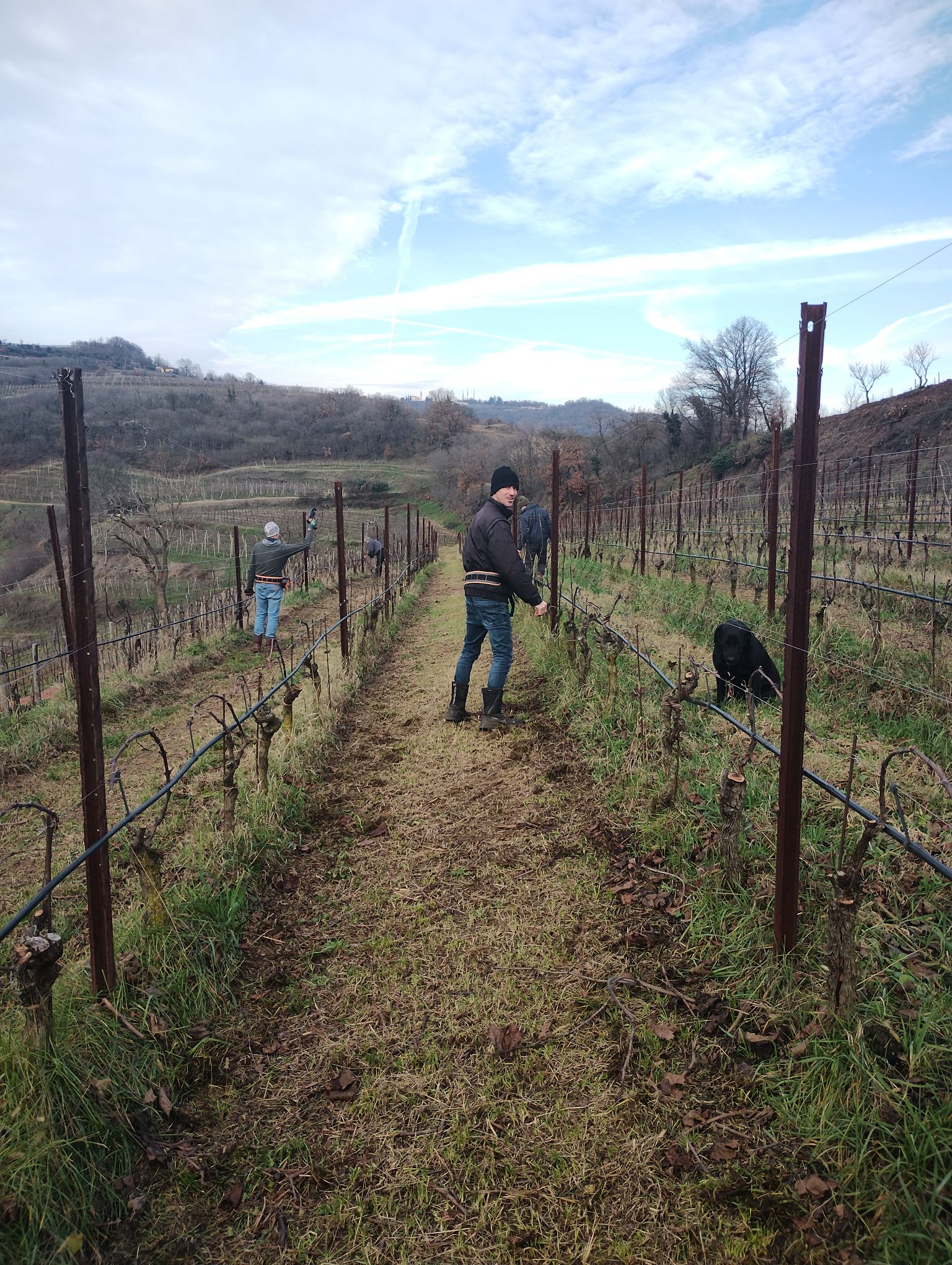
As with 2023, for the centre and north of Italy, the months of March and early April were warmer than average. (Temperatures in north-east Italy were reportedly 2.5°C warmer than average.*) Consequently, bud-burst was two weeks earlier than normal for many growers. But then temperatures dropped.
In the Veneto, from mid-April and into May, with the lower than average temperatures, the vines’ vegetative development slowed significantly. Flowering started earlier than normal but was blighted by frequent rainfall “resulting in a lower than average fruit set percentage in some cases.”
Speaking to Bepi Baldessari (located in Povo di Trento up in the Dolomites) he told me that the cold spring caused his chardonnay bunches to be 1/3 to 1/2 their normal size. The grapes he eventually harvested were healthy, phenolically ripe, but half the quantity of a typical year.
Across northern Italy, June was also colder than average (between 1.5 – 3°C cooler than average in the north-west*) and more rainy (precisely +39% more rainfall compared to the average for central Italy, again according to the agronomists at Vitenova*) and the pressure to fight downy mildew was felt by many winemakers.

Bruna Ferra, matriarch at the biodynamic winery Carussin in Montferrato, Piedmont put a positive spin on the situation: “2024 was a rainy year! However, we are absolutely not complaining! Water, in this year 2024, was an absolute priority! All the plants, not only the vines, were very thirsty and needed to stock up on water! The spring and summer rains were very invigorating and essential. Of course, the work in the vineyard to contain vegetation and infections was intense, but we are not complaining! The sight of the plants and the soils amply quenched repaid us and it was a real joy to see the plants, finally, without thirst!“
Summer 2024 was hot up and down the boot ; whilst temperatures were not necessarily record-breaking, they were consistently hotter than average. There was an “African anticyclone” which created a “heat dome” causing high temperatures for a sustained period, particularly in the centre and south (the mercury reached 45°C in parts of Puglia, Calabria and Sicily) but even in Friuli, for example, July was 2.6°C hotter and August 4°C hotter than average.*
In terms of rainfall, it’s as if someone drew a line across the middle of the country: half of the country got wet feet, whilst the other half is still gasping. In the north and north-east, the rainfall was abundant and fell mainly during the months of May, September and October… (ever found a more effective way of making growers shudder?!) Sicily saw some rainfall in January, early spring and August but overall, the island is still suffering from a scarcity of water. Puglia and Basilicata, on the other hand, didn’t get nearly as much rain and, as such, they also still have a drought warning in place for the third consecutive year. Obviously.
Speaking of which, what about for winemakers in the south of Italy?
“Unusual from the start,” replied Marta Cesi, founder and owner of the Dei Agre winery in Salento, Puglia. “Autumn and winter were dry; the rains (which for us means a day maximum two) arrived in early March, a couple of days at the end of April, on May 1st and July 7th.”
“After that, we no longer needed to spray the vineyards, because it was so hot. Ripening was accelerated by the torrid temperatures that reached a maximum of 42°C and that dropped to 27°C at night (not a significant temperature range as the heat did not give any respite even at night). We recorded a drop of 10 degrees from September 9th but we had already harvested from August 12th to 29th. The sugar content was already high and the plants, without irrigation, could not support the fruit for much longer.”
And as for the harvest?
Bruna at Carussin: “quantity was down but what we did “bring home” was healthy, with slightly lower gradations compared to previous years, but with surprising acidity and finally a great balance especially in the wines made from our local variety: barbera.“
It was a similar situation in the Langhe. When I asked Le More Bianche the immediate, tongue-in-cheek response was “do you have a back-up question?!” Pressed further, they told me: “it was a cold and wet growing season and we lost a lot of fruit, but the wines have actually turned out alright. Lighter, more ephemeral, but at least they’re not the concentrated fruit bombs from the previous, hotter years.“
Harvest 2024 at La Biancara (on the Verona/Vicenza boundary) is best described as torturuous. We had a Japanese chef called Taiyo come for a few days and with a name which means “sunshine”, we thought he might bring a break in the weather. But, whenever we got our team together to go harvesting, even though rain was not forecast, the heavens would open sometime mid-morning. Then, whenever it was forecast to rain and we’d tell everyone to stay home, it stayed dry. Even when we could get into the vineyards, it was only while wearing Wellington boots and winter clothing because the temperatures were unseasonably low. Fortunately, we also had a four-time Olympic athlete harvesting with us for a month; Gloria taught us how to sprint!

Harvest was more satisfying for those south of the Po river; in Emilia-Romagna, Camillo Donati (who makes frizzante wines near Parma) had an abundance of grapes. Whilst we normally tease Camillo that he has wrapped up his harvest before we’ve even got going, in 2024, he endured his longest harvest in recent memory.
It was much the same for the Frascole winery just north-east of Florence, in Chianti Rufina. “It was a very long harvest,” Enrico Lippi told me, “we had to go through the vineyards many times. When we picked the white grapes, it was all looking relatively promising, but then when we reached the moment to get started with the sangiovese, the rain started.”
Down in Puglia, Marta says: “We worked well in the vineyards, in particular in terms of the soil management and passing twice doing a green pruning, trying to strip as few leaves as possible in order to maintain a good leaf wall to protect the bunches and support photosynthesis during the ripening phase.“
“The grapes we harvested were healthy, beautiful and certainly in greater quantities than the 2023 when we could only make rosé wine, and we harvested the first crop from a 4 year old vineyard planted with a white variety. Considering that vineyard has overcome the two difficult years, it can be defined in all respects as resilient and tenacious. The problem in 2024 was that the fermentations were difficult, they blocked a couple of times; the pH of the must was high… Going forward, I’m going to have to study oenology more! Even if the grapes are healthy, I have learnt that wine cannot be made without knowing all the biological dynamics. As much as plants and humans can adapt to external conditions, the temperatures inside the cellar must be managed better. I also want to increase the diversity in my vineyards, by planting more evergreen plants. We really do have the most beautiful job in the world!”
On 25th July 2023, Diego Bongiovanni at Cantina del Malandrino on the eastern slopes of Mount Etna in Sicily was victim of wildfires that wiped out his harvest. This year finally, I summoned the courage to ask what, if anything, he’d been able to grow. “Mostly leaves, but it’s amazing.”
“In 2024, the vineyard rose from the ashes. It turns out that 70% of the vines survived; the rest, well, we will have to start again. Observing the strength of nature that resists even after fires, observing how the entire ecosystem has started again, or rather, has continued to live, perhaps even with renewed energy, made me understand (or perhaps I like to think) that my project to farm sustainably has not weakened the ecosystem. It has given me strength and stimulated me to activate hidden energy and creativity, which I didn’t realise I had. Almost a new youth. Like plants, my organism has also been regenerated by the fire. So, beyond the economical aspect (and economy is purely a human invention), the experience has been positive.”
And in this period of global uncertainty and anxiety, I leave the last word to Bruna at Carussin: “this was my 46th harvest, and never before have I reflected on “speed”! The surprising speed that Plants and Animals have in optimizing everything they have available. This particular harvest has taught me: make the most of what you have available, live well in the here and now, with respect and love, and, surely tomorrow will be better!“
Full disclosure: Many of the wineries mentioned in this blog post are part of VinNatur, an association for which I work… but all of the winemakers quoted in this piece are people I’m proud to be able to call friends.
‘* Thanks to the agronomists at Vitenova for putting together the technical data.
Other sources: Energy & Climate Intelligence Unit “Italy: climate impacts in focus“
& Meteo Giornale “Summer 2024: Extreme weather in July and August could disrupt autumn in Italy“

Leave a comment